By MisterGamblers
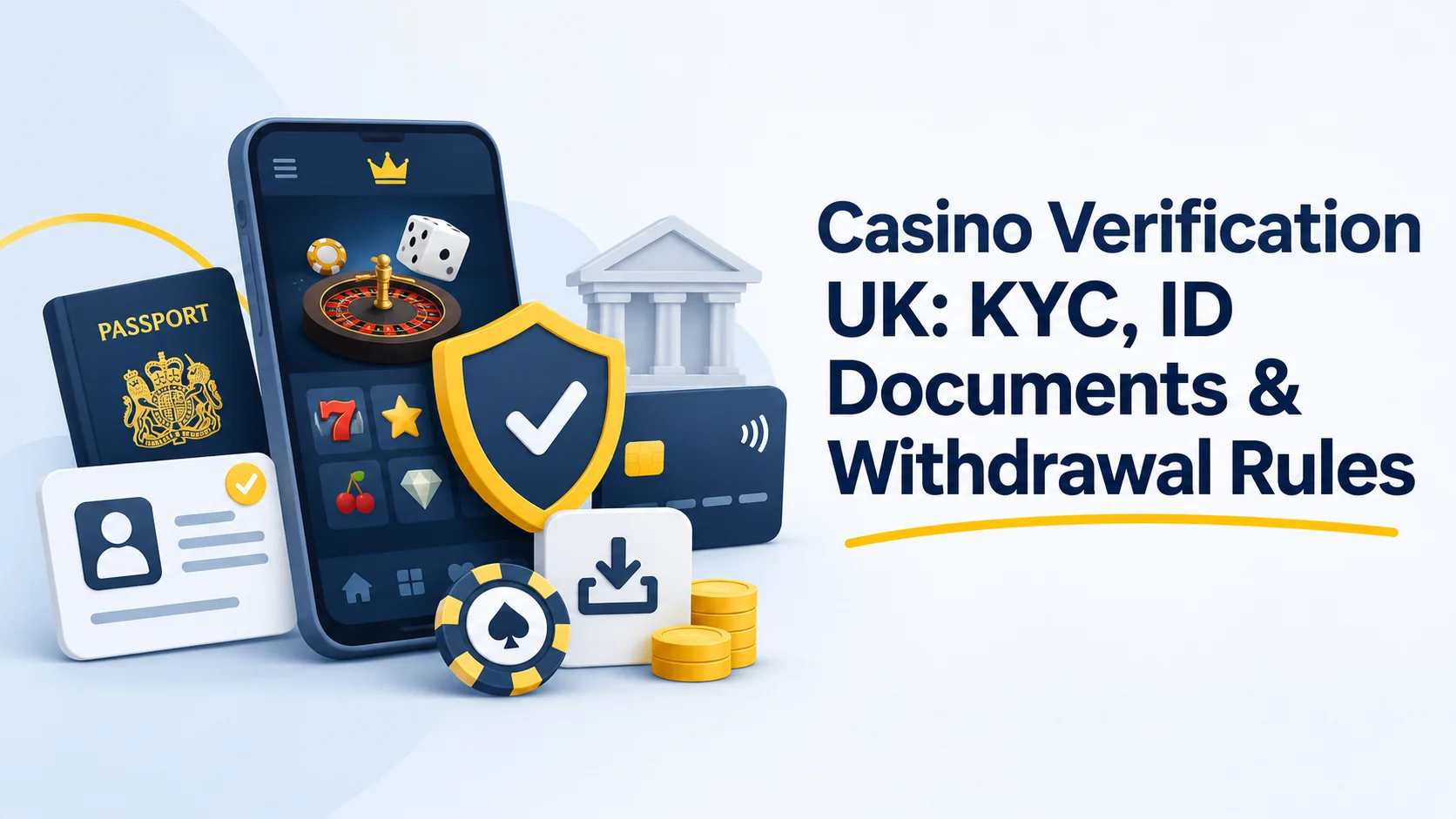
Casino Verification UK: KYC, ID Documents & Withdrawal Rules
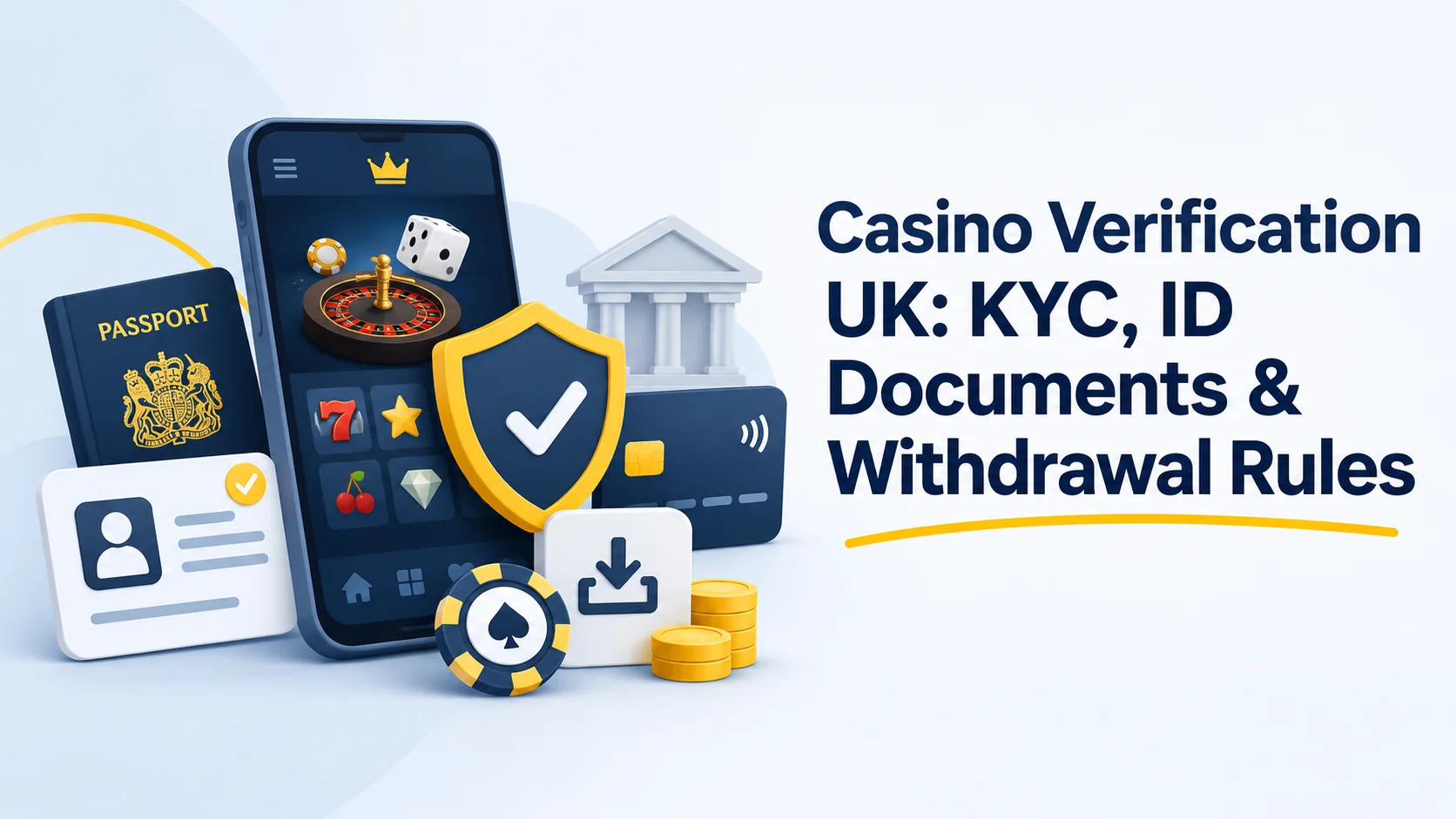
UK online casinos must verify your age and identity before allowing you to gamble. That does not mean everyone must upload a passport: many people are verified through electronic checks. Other customers may need to supply ID, proof of address or further information. A casino may also carry out additional checks later, including around a withdrawal, where there is a proper legal reason.
This guide explains the rules for casinos licensed by the UK Gambling Commission (UKGC), what commonly happens during verification and what you can do when a request is delayed or disputed. It also distinguishes identity checks from source-of-funds enquiries and explains why offshore “no-KYC” claims are not equivalent to British regulatory protection.
| At a glance | What to know |
|---|---|
| Before gambling | UKGC-licensed online operators must establish a customer’s identity, including name, address and date of birth. |
| Documents | Electronic databases may be sufficient; further documents depend on the case. |
| Withdrawal requests | A casino cannot routinely defer information it could reasonably have sought earlier solely until withdrawal; other legal duties can justify additional checks. |
| Timing | There is no universal UKGC completion time for identity checks. |
| Disputes | Start with the operator’s complaints process; eligible unresolved cases can progress to alternative dispute resolution. |
What Is Casino Verification?
Casino verification is the process a gambling operator uses to establish that an account belongs to the person using it and that the person is eligible to gamble. “KYC” means Know Your Customer. In practice, the process may combine age checks, identity matching, fraud controls and later monitoring for financial crime or other risks.
For an online casino licensed in Great Britain, UKGC Licence Condition 17.1.1 requires the operator to obtain and verify information establishing a customer’s identity before permitting gambling. The information must include the customer’s name, address and date of birth. The operator must also take reasonable steps to keep identity information accurate.
Opening an account is therefore not the same as receiving permission to gamble. Nor is passing an initial identity check a promise that the operator will never request more information. Some later enquiries arise from anti-money-laundering duties, suspected fraud or changes in the customer’s circumstances.
When Do UK Online Casinos Verify Your Identity?
Before you can gamble
The first identity check takes place before a customer is permitted to gamble. An operator may compare account information with trusted electronic sources, including credit-reference or electoral-roll information. If the data cannot be matched reliably, the operator may ask for documentary proof. The UKGC’s player guidance explains that an electronic match can be instant, while a document review may take longer.
Before accepting a deposit, the operator should explain what categories of identity evidence it might need, when the request might arise and how documents should be provided. Read the account and verification terms instead of assuming a successful registration screen means all checks are finished.
Why more checks can happen later
A later request is not necessarily evidence that an operator has broken the rules. A change of personal details, suspected account misuse, unusual transactions or a legal anti-money-laundering obligation can justify further checks. The crucial distinction is whether the operator could reasonably have requested the same information sooner and whether another legal obligation genuinely requires it now.
A practical account timeline is: registration → electronic identity matching → document review if needed → permission to gamble → ongoing monitoring → withdrawals, with additional enquiries where justified. Not every customer encounters every step.
What Documents Do Casinos Ask For?
The UKGC does not prescribe one fixed document pack for every player. Operators choose suitable evidence for the facts they must verify, so the documents requested can differ even between two UK-licensed casinos.
| Evidence | Common examples | Why it may be requested |
|---|---|---|
| Identity | Valid passport or driving licence | To establish identity and date of birth |
| Address | Recent utility bill, bank statement or other accepted address evidence | To confirm the residential address where electronic matching was insufficient |
| Payment ownership | Limited account or payment-method details | To establish that payments relate to the correct account holder |
| Security check | Selfie or additional identification | To address suspected impersonation or account fraud |
| Financial evidence | Bank statements or information about income or a transaction | For separate source-of-funds or risk enquiries |
Proof of identity and address
A passport and driving licence are common examples of photo ID. A household bill is one example of address evidence mentioned by the UKGC. Operators may impose specific requirements about recency, image quality, visible details or document type. Check the casino’s current instructions before submitting anything. Do not alter documents or assume an expired document will be accepted.
Payment ownership and selfies
If the operator asks about a payment method, it should explain the information necessary to establish ownership or resolve a transaction concern. A selfie may be relevant to suspected fraud or identity theft. Requests should be proportionate to the concern and communicated through official account channels. Never email full card credentials, passwords or one-time codes in response to an unsolicited message.
How Does Online Casino Verification Work?
Most verification journeys follow a recognisable sequence, although the exact interface varies by operator:
-
Enter accurate personal details, including your legal name, date of birth and residential address.
-
The casino attempts to confirm those details through electronic information sources.
-
If the match is insufficient, it asks for particular documents or additional information.
-
You submit the requested evidence through the operator’s authenticated website or app.
-
The operator reviews the evidence and confirms whether the account can be used, or explains what remains outstanding.
Use the same personal details across the account and submitted evidence where appropriate. If a name has changed or the address records are outdated, explain the discrepancy rather than repeatedly uploading the same file. Keep the request reference, dates and the operator’s response in case you later need to make a complaint.
Before sending sensitive documents, check the operator’s licence and domain in the UKGC public register. A convincing-looking casino logo does not establish that a website is authorised to serve customers in Great Britain.
How Long Does Casino Verification Take in the UK?
There is no universal verification deadline that applies to every UK casino account. The UKGC says electronic checks may be completed instantly, whereas checks involving document review can take longer. The time depends on the information available, the reason for the request and the operator’s review process.
If your status remains pending, look for a message explaining what is outstanding, check whether the document has been received and ask support for a clear update. Avoid accepting a claimed fixed “UK legal verification time” from a casino comparison site: the regulator does not publish a single completion time that guarantees all cases will be resolved within a set number of hours.
Can a Casino Ask for ID Before a Withdrawal?
What UKGC Licence Condition 17.1.1 says
UKGC-licensed online casinos must verify identity before gambling. The same licence condition restricts operators from making a withdrawal conditional on additional information that they could reasonably have requested earlier. Its wording also expressly preserves information requests that are necessary at that time to meet other legal obligations.
For example, an ordinary proof-of-identity request that could reasonably have been completed at registration raises a different issue from a newly triggered anti-money-laundering enquiry. Whether a particular delay breaches the rules depends on the facts, not merely the point at which the casino contacted you.
What to ask when a payout is delayed
Ask which specific check remains outstanding; whether it concerns identity, payment ownership, fraud or another legal obligation; when the requirement arose; which documents are acceptable; and how you will be updated. Keep a record of the withdrawal date, amount and status.
A pending payment can have causes unrelated to KYC, such as the operator’s approval process, payment-provider processing or payment details. Read our guide to casino withdrawal processing times and the explanation of why casino withdrawals remain pending for related issues. Quoted payout times should never be read as a guarantee that verification will be complete.
Source-of-Funds and Source-of-Wealth Checks
Source-of-funds checks concern where money used for a transaction or gambling activity came from. Source-of-wealth enquiries examine a person’s broader economic circumstances and how wealth was accumulated. Neither is the same as confirming a name, address and date of birth.
A casino may request bank statements, information about income or an explanation of a particular transaction as part of its financial-crime and customer-risk procedures. An operator should be able to describe the purpose and acceptable submission route, although it may be unable to disclose every detail of a financial-crime investigation.
These enquiries can involve sensitive records. Share information only through secure official channels, read the operator’s privacy information and ask which specific pages or details are needed if the request appears excessive. Do not submit false or edited financial records. The UKGC’s guidance on age, identity and financial verification gives examples of why operators seek bank-statement and income information.
What If Casino Verification Is Rejected or Delayed?
First establish precisely what has happened: the casino may have rejected a document, failed to match an address, suspended access because of suspected fraud or paused a payment pending a separate financial check. The appropriate response is different in each case.
| Problem | What to check | Next step |
|---|---|---|
| Document rejected | Expiry, legibility, missing fields, mismatched name or address | Ask for the exact rejection reason and accepted alternatives |
| Electronic check fails | Personal details, recent move or name change | Correct genuine errors and ask about manual verification |
| Withdrawal held | Whether the check was foreseeable earlier or newly required | Request the type of check and a written explanation where possible |
| Financial records requested | Which transaction or source is being examined | Ask for secure submission instructions and necessary scope |
| No useful response | Dates, support transcripts, request numbers and terms | Submit a formal complaint and retain evidence |
Ask for a specific reason
A helpful support request identifies the account, the date verification began, the documents already submitted and the question you need answered. Avoid sending repeated uploads without knowing why the earlier evidence failed. If the operator requests a new document, ask what was wrong with the previous one.
Protect your documents
Sign in directly through the operator’s official website or app. Avoid document requests sent through unfamiliar messaging accounts or links you cannot authenticate. Keep copies of correspondence, but do not post photographs of IDs or bank statements publicly when asking for help.
Make a formal complaint and use ADR if eligible
If customer support does not resolve the issue, follow the casino’s published complaints procedure. Give the dates, relevant sums, requested remedy and supporting evidence. Under the UKGC complaints process, the gambling business has eight weeks to resolve a complaint. If it remains unresolved, or reaches the appropriate deadlock stage, you may be able to refer an eligible dispute to an alternative dispute resolution (ADR) provider.
The UKGC regulates operators but is not a substitute for the individual complaints and ADR process. A complaint about identity verification is not automatically a guarantee that the disputed withdrawal must be paid immediately.
What happens to deposited money if verification fails?
A failed identity check should not automatically allow a casino to confiscate the remaining deposit balance. The UKGC’s identity-verification fair-terms guidance warns operators against terms that remove deposit funds merely because a customer cannot satisfy identity requirements. The regulator also describes limited circumstances for later account-maintenance fees after prolonged unsuccessful verification and required safeguards. The treatment of other balances or suspected unlawful activity may involve additional facts and legal duties.
UKGC Casinos vs Offshore Crypto Casino Verification
A casino’s claim that it requires “no KYC” is not proof that its customers are protected by British gambling rules. Operators licensed by the UKGC must verify age and identity before gambling; offshore operators may apply different policies, may demand documents at withdrawal and may not provide equivalent complaints or consumer-protection arrangements.
Crypto deposits are not inherently anonymous, and payment in Bitcoin or another token does not remove the risk of later account or source-of-funds checks. Nor does being able to open a website establish that its operator is authorised to offer gambling to customers in Great Britain.
Our crypto casinos guide examines licensing differences and KYC claims. It should be used to understand the risks, not as a route around verification obligations. Before using an online casino in Great Britain, check its current licence and website domain on the regulator’s public register.
How MisterGamblers Evaluates Casino Verification Policies
When reviewing verification policies, MisterGamblers focuses on information readers can verify: the named operator and licence, the documentation described in its terms, when checks may occur, withdrawal-related conditions, payment-ownership requirements and routes for complaints. We distinguish statements made by operators from rules published by the UKGC.
A review may identify gaps or inconsistencies in publicly available information, but it should not imply that an actual account verification or real-money withdrawal was tested unless that activity is documented. Verification terms can change, so readers should check the operator’s current policy before submitting personal information. For differences between payment options, see our casino deposit methods guide.
Frequently Asked Questions
Do all UK online casinos require ID verification?
Yes. UKGC-licensed online operators must verify a customer’s age and identity before allowing gambling. This can happen electronically; it does not mean everyone must upload a physical ID document.
Can I gamble before verification is complete?
You must be verified before being permitted to gamble with a UKGC-licensed online operator. Creating an account alone does not satisfy that requirement.
Why is my casino asking for documents when I withdraw?
The casino may be carrying out a newly justified fraud, payment or anti-money-laundering check. However, it must not routinely postpone information that it could reasonably have requested earlier and then use that information as a withdrawal condition.
Can a casino ask for bank statements or payslips?
Financial information may be requested where relevant to legal or risk obligations. Ask the operator why it needs the information and how to submit it securely. Such requests are different from basic name, address and date-of-birth checks.
How long does online casino verification take?
There is no single UKGC time limit for every account. Electronic checks may be instant; manual document reviews can take longer.
What happens if my verification fails?
The operator should explain what information is missing or unacceptable, subject to legitimate confidentiality limits. You may need to correct details or provide an accepted alternative. A failed identity check does not automatically entitle the operator to confiscate a deposit balance.
Does paying with PayPal remove the need for KYC?
No. A payment provider’s own account checks do not replace the UK-licensed casino’s obligation to verify its customers. Payment options also differ in withdrawal availability and terms.
Can an online casino ask for a selfie?
Yes, where there is a legitimate reason such as suspected fraud or identity misuse. A request made only at withdrawal raises a separate issue if the information could reasonably have been requested earlier.
What should I do if a casino refuses to finish verification?
Request a clear explanation, keep records and use the operator’s formal complaints process. Eligible unresolved disputes may then be referred to ADR after the necessary complaint steps.
Final Takeaway
Verification is a standard part of gambling with a UKGC-licensed online casino. Most important is not the number of documents requested, but whether the checks have a clear purpose, happen at the appropriate time and are communicated fairly. Confirm the operator’s licence, use secure submission channels and ask for a written explanation if a request is delayed. Where an issue remains unresolved, use the casino’s complaints procedure and the available ADR route rather than accepting an unexplained hold indefinitely.